Gen Z can keep Pahadi jewellery knowledge in circulation by learning ornament names, recording family accounts with permission and wearing suitable pieces with contemporary clothes. Start with one item, check its fit and condition, and share what is known without inventing origin stories. Buying jewellery is optional.
Yes, young people can help keep Pahadi jewellery traditions alive by learning the names, recording family knowledge, wearing suitable pieces in ways that feel natural, and treating makers and owners with respect. Buying a large collection is not a requirement. Nor does a connection to Uttarakhand depend on reproducing somebody else's wedding outfit every time you leave home.
A traditional ornament becomes easier to understand when it joins an ordinary wardrobe. You notice where a collar necklace sits against a shirt, which earring catches on a scarf, and whether an inherited fastening needs attention. Those observations turn admiration into familiarity. Style can open the door, but the lasting work happens when somebody asks what the piece is called, remembers the answer and passes it on accurately.
For Gen Z readers, the practical question is less “Can we preserve everything?” and more “What can we learn and use responsibly this week?” Start with one piece, one conversation and clothes you already own. There is room for experiment, uncertainty and a changing personal style. Cultural confidence can grow from knowing a little more than you did yesterday.
Continuity leaves room for a new choice
UNESCO describes intangible cultural heritage as community-recognised practices, knowledge and expressions transmitted across generations and adapted over time. That broad framework makes room for learning as well as change. It does not mean every contemporary jewellery design has a UNESCO designation, and it does not certify a brand. It does offer a useful reminder that keeping knowledge in circulation involves people, not only keeping objects in a box.
Applied to a family ornament, continuity might mean remembering its local name, understanding when a relative wore it and learning how to secure it correctly. A new choice might be wearing it with a plain shirt instead of the outfit in an older photograph. These are different actions. You can adapt the styling while preserving the account of its earlier use, rather than rewriting that history to match your own preference.
Some people feel close to their family's customs; others have had less chance to learn them. Migration, distance, language and complicated family relationships can all shape access to knowledge. Do not turn heritage into a competition over who knows the most words or owns the oldest piece. Asking a careful question is a valid beginning, even if your answer is that you are still learning.
If a specific ornament has a ceremonial context in your household, discuss that before treating it as an everyday accessory. A private owner may have reasons for limiting its use. Listening does not require accepting every claim uncritically; it means understanding the person and the context before deciding what to do. Your own contemporary piece may offer more freedom than a borrowed object with particular responsibilities attached.
A hansuli with a shirt or a T-shirt
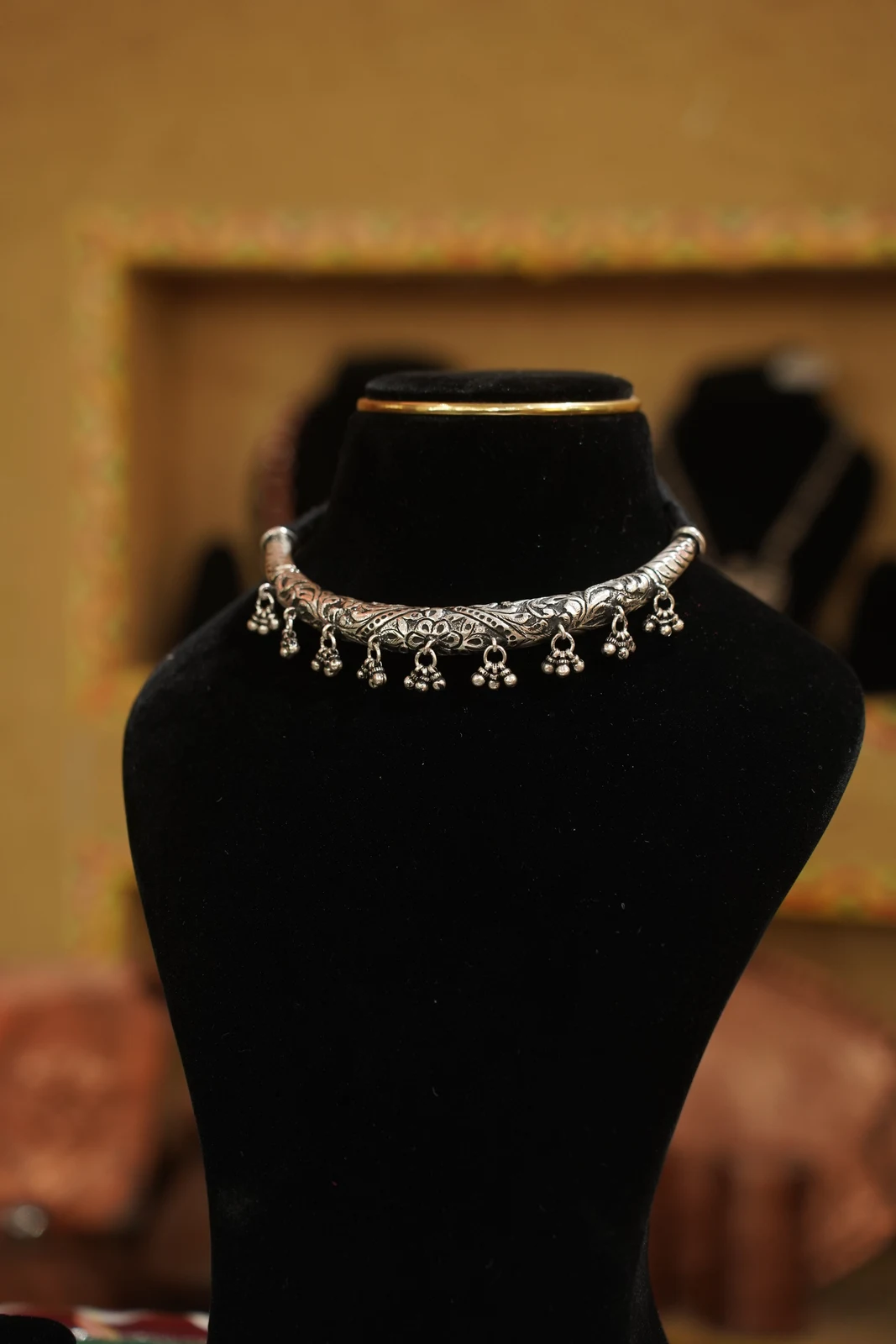
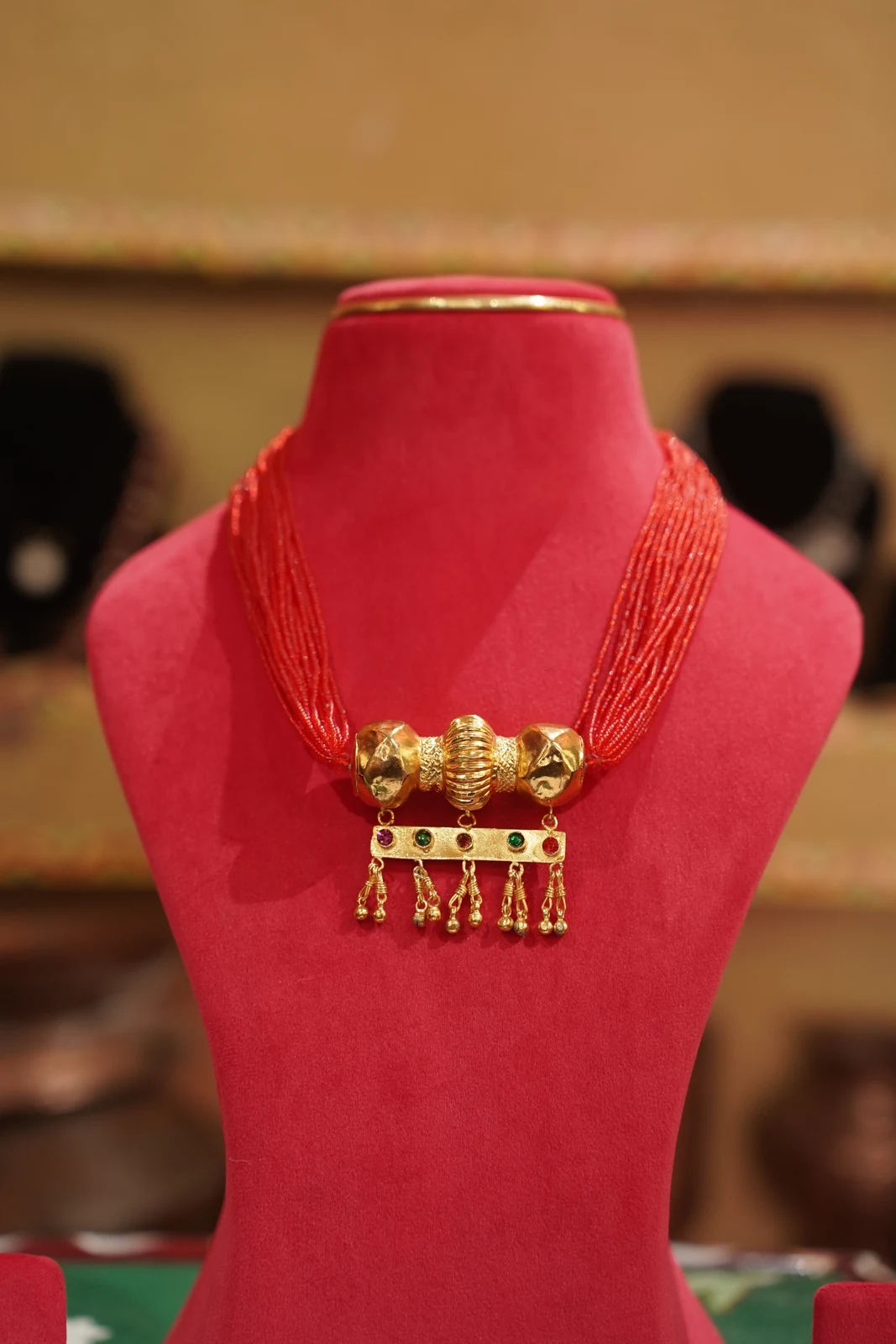
The Indian Family Jewels exhibition identifies the hasli or hansuli as a rigid collar necklace. That shape is a useful starting point for styling because it does not behave like a soft chain. It needs room to sit in its intended position. Do not assume it will lie neatly under every collar, and do not bend it to solve a wardrobe problem.
With a button-down shirt, try the necklace against the open neckline and then over the closed shirt, if its shape and fit allow. These can produce very different outlines. Check the view from the side: a collar point may push the ornament upwards or cover part of its design. Move your shoulders and look down to see whether the arrangement shifts. A clear front photograph cannot substitute for that small movement test.
A plain T-shirt can give a detailed piece an uncomplicated background. Compare the actual neckline with the bottom edge of the necklace. If both sit at almost the same level, the fabric may partly hide the metalwork or cause rubbing. A different neckline may give it more space; you do not need to change the whole outfit. Try this with clothes already in your drawer before shopping for a supposedly perfect heritage look.
Choose sleeves and layers with the day in mind. An open overshirt may frame the necklace, but a bag strap or tightly zipped outer layer can disturb it. If you travel wearing headphones, carry a backpack or spend time at a desk, test those everyday movements too. Taking the necklace off for part of the journey is a practical decision, provided you have a secure container and somewhere safe to keep it.
Dresses, knitwear and the question of space
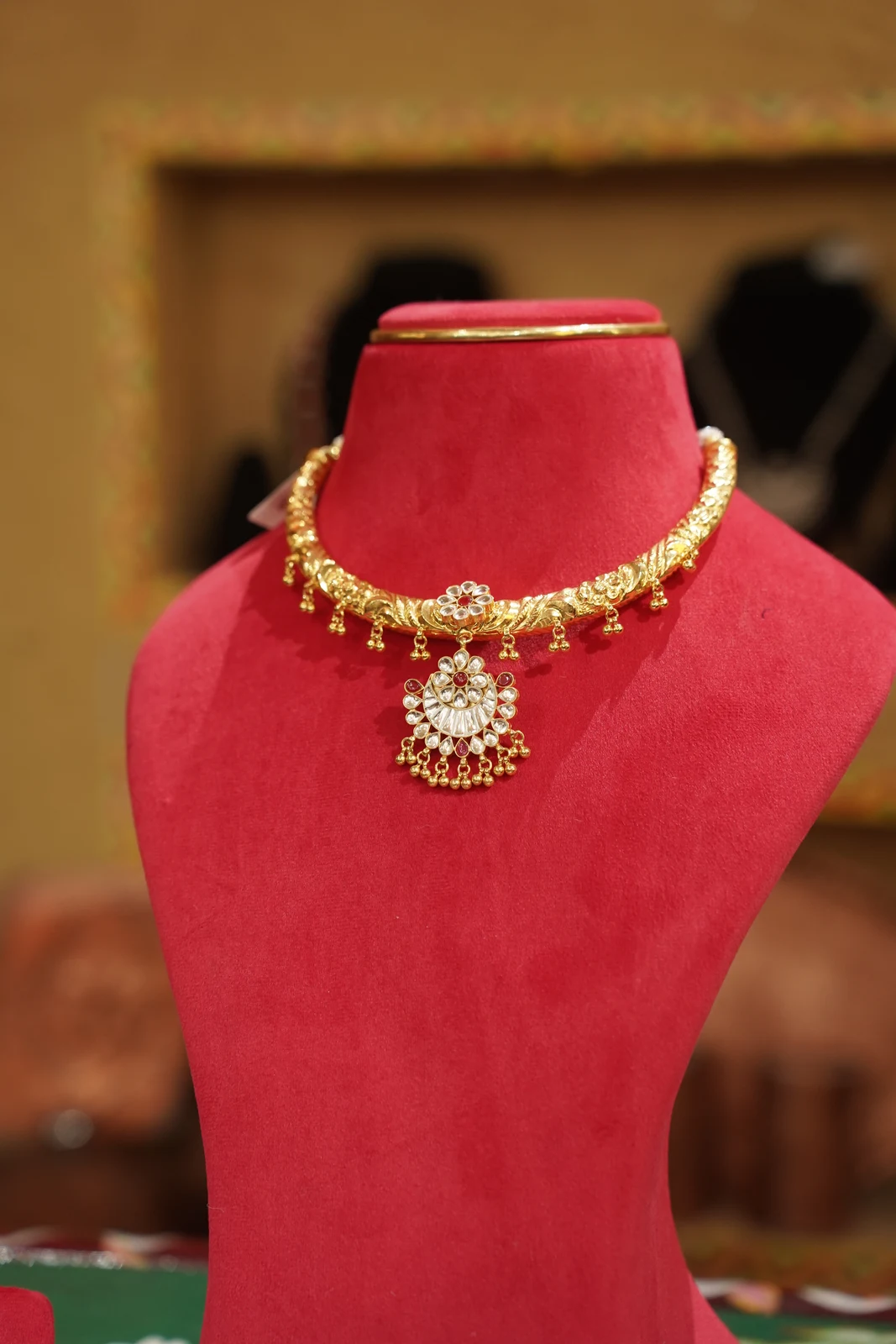
With a dress, look first at the neckline rather than the label on the garment. A broad collar ornament may sit differently above a square opening, within a rounded opening or against a high neckline. Your own proportions and the piece's dimensions decide what works. Styling suggestions are experiments, not fixed rules about what a particular body should wear.
Start with one visual point of interest. If the dress has a busy print, detailed embroidery or a decorative neckline, try an earring instead of adding a necklace immediately. If the fabric is plain, a collar piece can become easier to see. Take an ordinary mirror photograph at your usual distance; a close crop can make every combination appear balanced while hiding the rest of the outfit.
Knitwear needs extra care because loops and raised stitches can catch on edges or fastenings. Inspect the ornament, then try it gently over a smooth section of fabric without dragging it across the surface. Avoid wearing an insecure piece on a delicate knit. For a borrowed heirloom, protecting both objects matters more than making a particular outfit work. A different garment or accessory can solve the problem with less risk.
Scarves, hoods and high collars can compete for the same space as large earrings. Put on the full outfit and turn your head before leaving. If the earring catches, switch the layer or choose another piece. The aim is to enjoy wearing the ornament rather than spend the day guarding it against every movement. A simple combination that survives ordinary use is often the one you will return to.
Festive clothes without a compulsory full set
At a family celebration, ask whether any specific piece has a meaning connected to that occasion. You may choose a fuller arrangement than you would wear during the week, or keep one ornament as a clear link to the family story. Either approach can be thoughtful. Avoid treating the number of accessories as a measure of how much you respect your background.
For a kurta, sari, suit or another festive outfit, test the jewellery with the actual drape and sleeves. An ornament may look clear against a plain neckline but disappear beneath a border. A wrist piece may snag embroidered cuffs. If you want several accessories, add them one at a time and move normally between additions. This makes it easier to identify the item causing discomfort or catching fabric.
Try a photograph in daylight before judging colours. Silver-coloured metal, gold-coloured finishes and stones can look different under indoor lighting. Appearance does not establish purity or the material underneath a finish. Style the colour you can see, and use the seller's actual material information when deciding whether to buy or how to care for the piece. Those are separate questions.
A contemporary arrangement can also be modest in scale. Repeating one small detail across an outfit may feel more comfortable than reproducing an entire historical-looking ensemble. You do not need to invent a symbolic meaning for every curve or flower to justify your choice. Explain what attracted you: the shape, a remembered person, the name or the way the piece works with your clothes.
Balance is useful; comfort decides
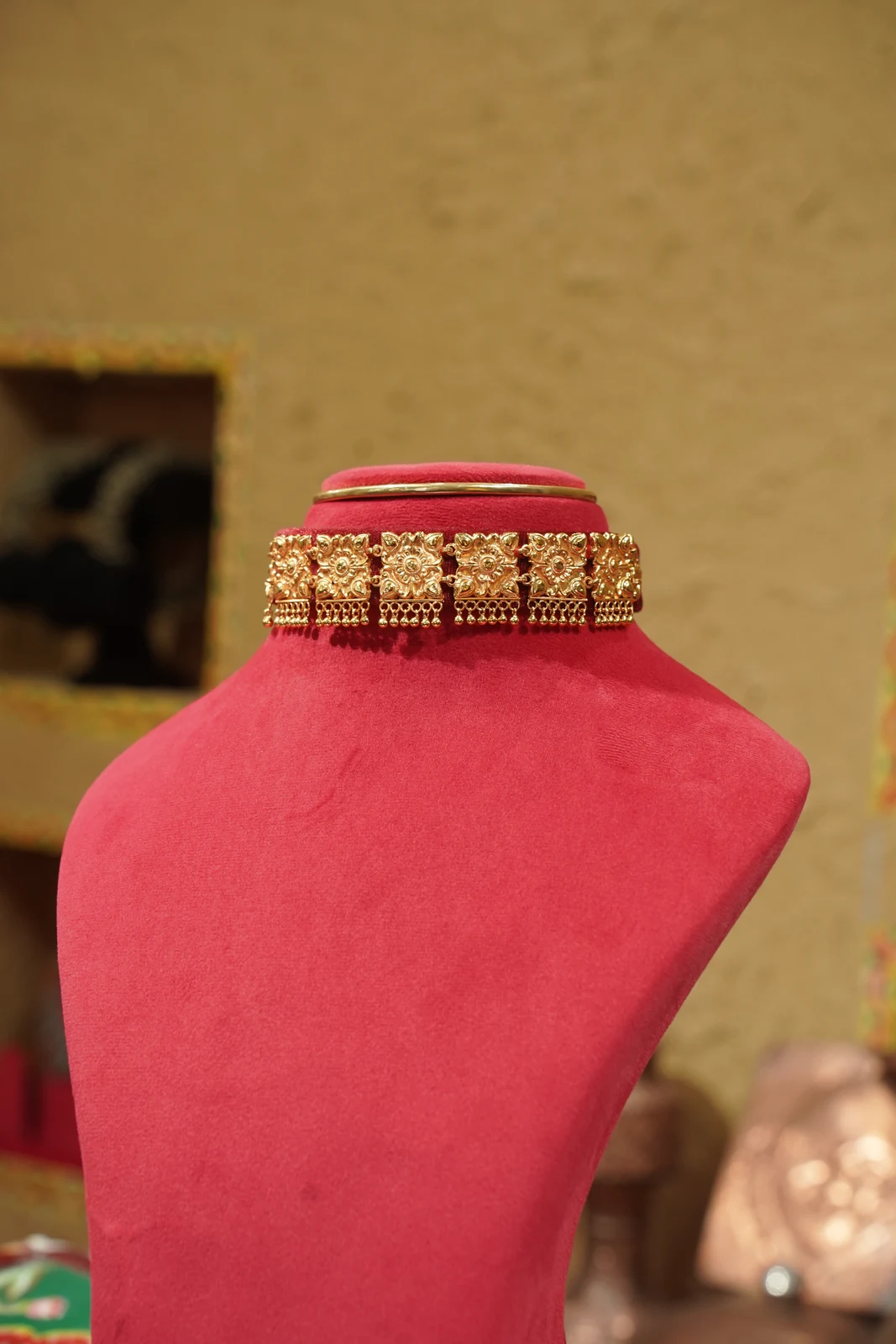
“Statement jewellery” is a shopping phrase, not a wearing obligation. A broad necklace with large earrings might delight one wearer and feel cumbersome to another. Assess your own tolerance and plans for the day. If you keep adjusting a piece or worrying that it will fall off, something needs attention, even if the combination looks convincing in a photograph.
Check closures before each use, particularly on an unfamiliar or older piece. Learn the right way to open them from the owner or a qualified professional. Do not pull at a component because it resembles a clasp on another necklace. If there is a rough edge, loose part or damaged tie, set the piece aside for assessment. Clothing cannot make an insecure fastening reliable.
For earrings, consider the movement of your hair and anything worn around your head or neck. For a collar piece, sit at your desk and turn your head. For wrist jewellery, check writing, typing and carrying your usual bag. These are modest tests, but they connect the styling decision to your actual life. Heritage jewellery need not be reserved for an imaginary day with no movement or work.
If a piece irritates your skin, stop wearing it and seek appropriate advice rather than assuming that irritation proves poor quality or a particular metal. The composition and fitting need proper assessment. Do not repeat purity claims based on colour, weight or a product name alone. Material information, comfort and craftsmanship should each be evaluated through the evidence relevant to that question.
Buy slowly, or begin by borrowing
Before buying, check what you already have access to. A relative may be willing to explain a piece, lend it for a particular occasion or let you study it without wearing it. Ask permission before photographing or posting it. A loan does not authorise repairs, resizing or cleaning, and enthusiasm for an outfit should not put pressure on someone to hand over a treasured object.
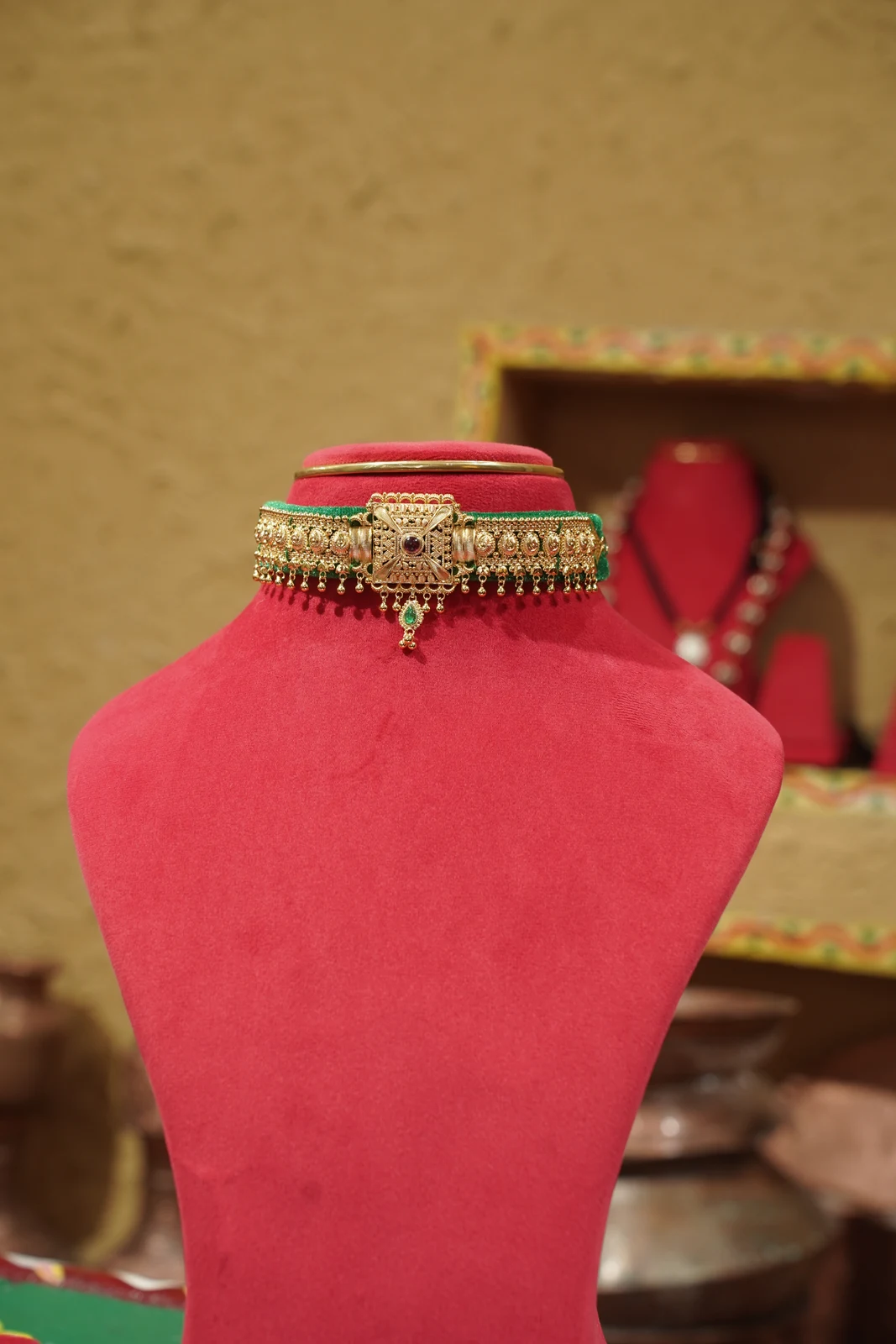
For a new purchase, ask concrete questions: what are the dimensions, what materials and finishes are documented, how does the fastening work, and what care does this specific item need? Confirm which parts of the description concern appearance and which concern composition. If a seller says a design draws on a regional tradition, ask what that statement means rather than assuming it proves where or by whom the piece was made.
When browsing Hansuli's current collection, treat each product as an individual item. Read the available description and ask the store about anything unresolved before ordering. A brand name, a silver-coloured photograph or a familiar ornament shape cannot establish the purity of the whole catalogue. Likewise, a modern design inspired by heritage should not automatically be described as an antique or a family heirloom.
Choose something that suits your budget and likely use. A piece worn repeatedly can build its own story without needing an older owner first. Learning a name, recording a relative's memory or sharing a source costs less than buying a complete wardrobe of jewellery. Your interest in Pahadi traditions remains valid if this year you choose to spend your money elsewhere.
Learn the story before writing the caption
Social media can introduce a name to people who have never heard it. It can also spread a confident mistake quickly. Before posting an ornament as “traditional Uttarakhand jewellery,” decide what you actually know about it. Is its provenance documented, its family connection remembered, or its regional inspiration described by a contemporary designer? Those are different kinds of information and deserve different wording.
Ask a family knowledge holder how they pronounce and spell the name. Record a variant spelling rather than correcting it merely because an online shop uses another one. If you share a voice recording, ask permission for that use specifically; consent to a private conversation is not automatically consent to a public reel. Let the speaker check a short caption when possible, especially when translating their words into English.
A useful caption can say that the pictured piece belongs to your family, name the person who explained it with their consent, and describe what remains uncertain. You do not need to claim a precise age, sacred meaning or regional origin to make it interesting. An honest account of how you learned something gives others a way to ask questions without feeling they must already know everything.
Keep visible credits for photographers and contributors, and ask about rights before reusing an image. A picture found through a search engine is not automatically free to publish. Avoid presenting styled contemporary photographs as historical records or workshop evidence. The distinction protects the people involved and helps readers understand what the image really shows.
A seven-day experiment using what you own
On the first day, choose one safely wearable ornament and list its known details: owner, name, dimensions if available and any material documentation. Separate remembered information from facts established by records. If you cannot borrow or wear a piece, study a photograph with the owner's permission and use the week for learning rather than styling.
On the second day, try it with a plain shirt or T-shirt. On the third, compare it with a dress, kurta or another garment you already like. Record where it sits and which fabric details interfere. A couple of private photographs can help you compare, but do not leave the ornament on just to obtain an image if it feels uncomfortable.
Use the fourth day to check your usual outer layer, bag and working position. On the fifth, speak to someone who can explain a family or local connection. Ask one focused question rather than demanding a complete history. Keep their exact wording in your notes, including uncertainty. If no knowledgeable person is available, read an identified cultural source and record its limits.
On the sixth day, repeat the combination that worked best and see whether it still feels right after the novelty has passed. On the seventh, write a short private record of what you learned and what you will change. Share it only if the owner and any contributors agree. The outcome may be one outfit, a better question or a decision to repair a fastening before wearing the piece again.
A tradition can travel in a small habit
Do you need to dress traditionally every day? No single wardrobe can establish a person's cultural identity. You can wear a familiar ornament occasionally and still make an important contribution by learning, crediting and preserving accurate knowledge. Nor does styling a piece with jeans make its earlier family context disappear, as long as that context is remembered and the owner consents to the use.
Can someone without a Pahadi family connection appreciate the jewellery? They can begin with respectful questions, honest attribution and attention to any specific ceremonial context. Appreciation should not require pretending that another community's experience is one's own. Learning the difference between a general necklace form, a regional tradition and a contemporary brand helps make that respect practical.
Keeping Pahadi traditions alive is a long conversation rather than an outfit challenge. A young wearer may start with a shirt and a necklace, then discover a spelling, a fastening or a story worth keeping. When that knowledge travels with the object, the next person receives something more useful than a beautiful photograph. They receive a way to understand it, care for it and make an informed choice of their own.
Explore the current Hansuli jewellery collection
Ask Hansuli about a specific design, fit or material description