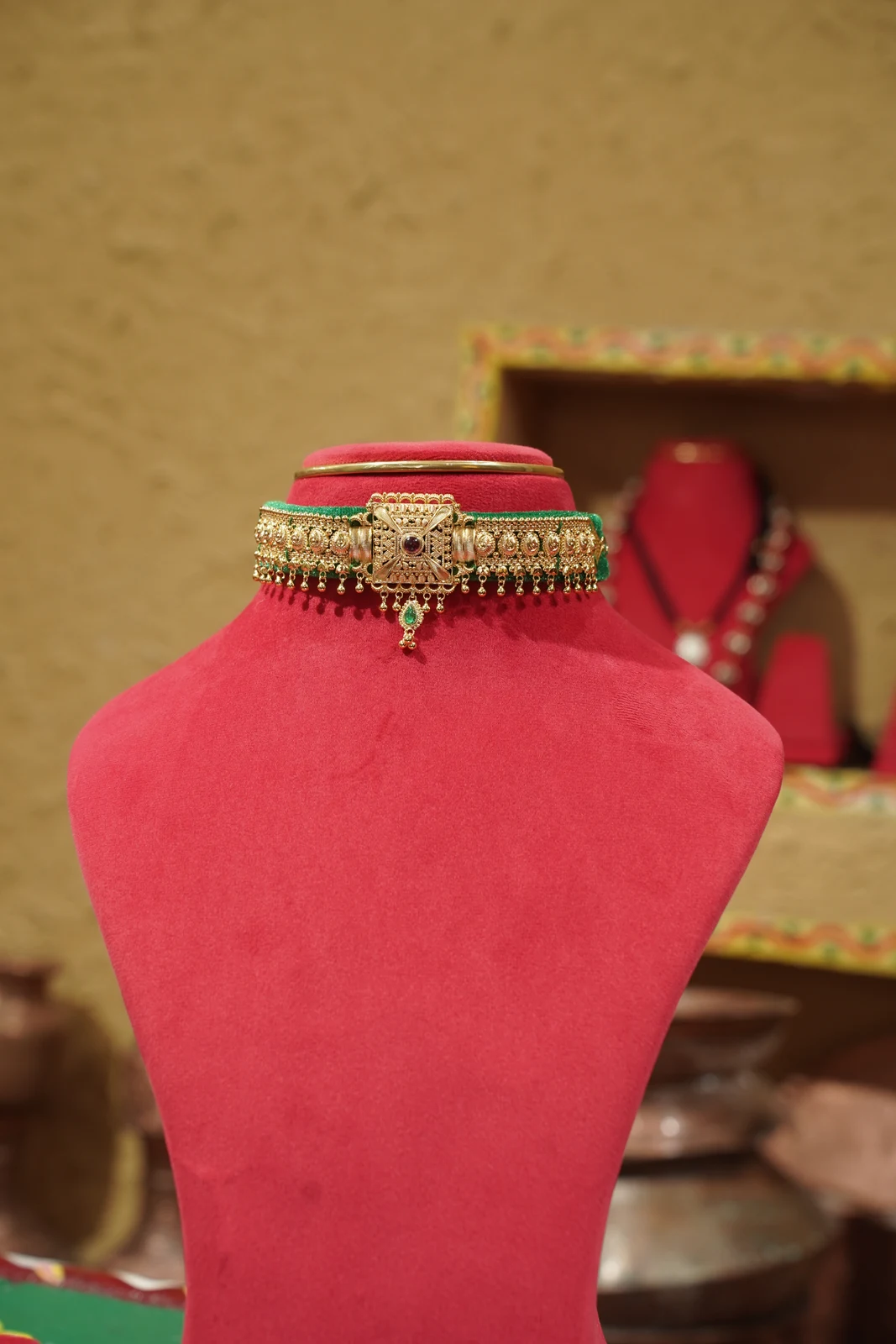
Kumaon and Garhwal provide useful regional contexts for Uttarakhand jewellery, but ornament names and shared forms do not prove exclusive origin. Compare documented designs, construction, language, clothing and family practice. Keep manufacture, purchase and use separate, and attribute specific local accounts rather than claiming every family follows one rule.
Put two family wedding photographs side by side and it is tempting to begin with a verdict. This one looks Kumaoni; that one looks Garhwali. A familiar necklace or nose ring seems to supply the answer before anyone has asked the families themselves. Sometimes the recognition is useful. Sometimes it misses the borrowed ornament, the marriage connecting two places, or the modern design chosen simply because the wearer loved it.
Kumaon and Garhwal offer meaningful regional contexts for learning about Uttarakhand jewellery. The most useful comparison looks at names, individual designs, documented provenance, clothing and family practice. It does not assign every ornament permanently to one side. A hansuli or a nath can carry a very particular family meaning even when its basic form belongs to a wider jewellery vocabulary.
The point of comparing is to see more, not to decide which family has kept tradition more correctly. Once that pressure is removed, the small differences become much more interesting.
A region is a starting point
The Garhwal division's official website identifies Garhwal as Uttarakhand's north-western region and one of the state's two administrative divisions. The Kumaon division website likewise locates Kumaon within Uttarakhand. These geographical frames help place a family account, but an administrative map is not a catalogue of exclusive ornament designs.
Garhwal division's official website
For a jewellery comparison, start smaller than the whole region. Which village or town does the family mean? Where was the piece bought? Where did the wearer live at the time of the photograph? Those places may be different. Recording each one gives a more useful picture than attaching a single regional label to everything in a jewellery box.
Dates matter too. A recently purchased ornament and a piece remembered from an older family photograph cannot automatically be treated as evidence of the same moment. Keep the date of the photograph separate from the presumed age of the jewellery. The older image may show a piece that was new then, while a current portrait may show something inherited.
This approach leaves room for a real comparison: two objects, two accounts, two documented contexts. It also avoids the vague idea that each region once had a uniform look which everyone must recreate today.
Begin the comparison with names
A name heard at home is often the first clue that jewellery belongs to a larger conversation. Keep that clue intact. Ask someone to say the word naturally, write it in the script they prefer if possible, and add an English spelling for readers who may be searching for it online. You do not have to replace a family word with a more fashionable label.
When spellings differ, compare the objects before treating the words as exact equivalents. One person may use a general category; another may mean a particular design within it. Ask whether the same word covers more than one shape in their family. A sentence such as “this is what we call this piece” is more precise than announcing that everyone in an entire region uses the name identically.
Nath and nathuli, hansuli and hasli, guloband and guluband can appear in descriptions or searches. Their presence gives you a place to begin asking questions. It does not by itself reveal the speaker's district or the object's workshop. Transliteration is an aid to finding information, not a test of belonging.
For a family caption, use the owner's preferred name followed by a plain description. Someone unfamiliar with the vocabulary can then understand the object without flattening the local word into “ethnic accessory.” Someone who does know the word can contribute a fuller account rather than arguing over an English spelling.
Compare collar ornaments by construction
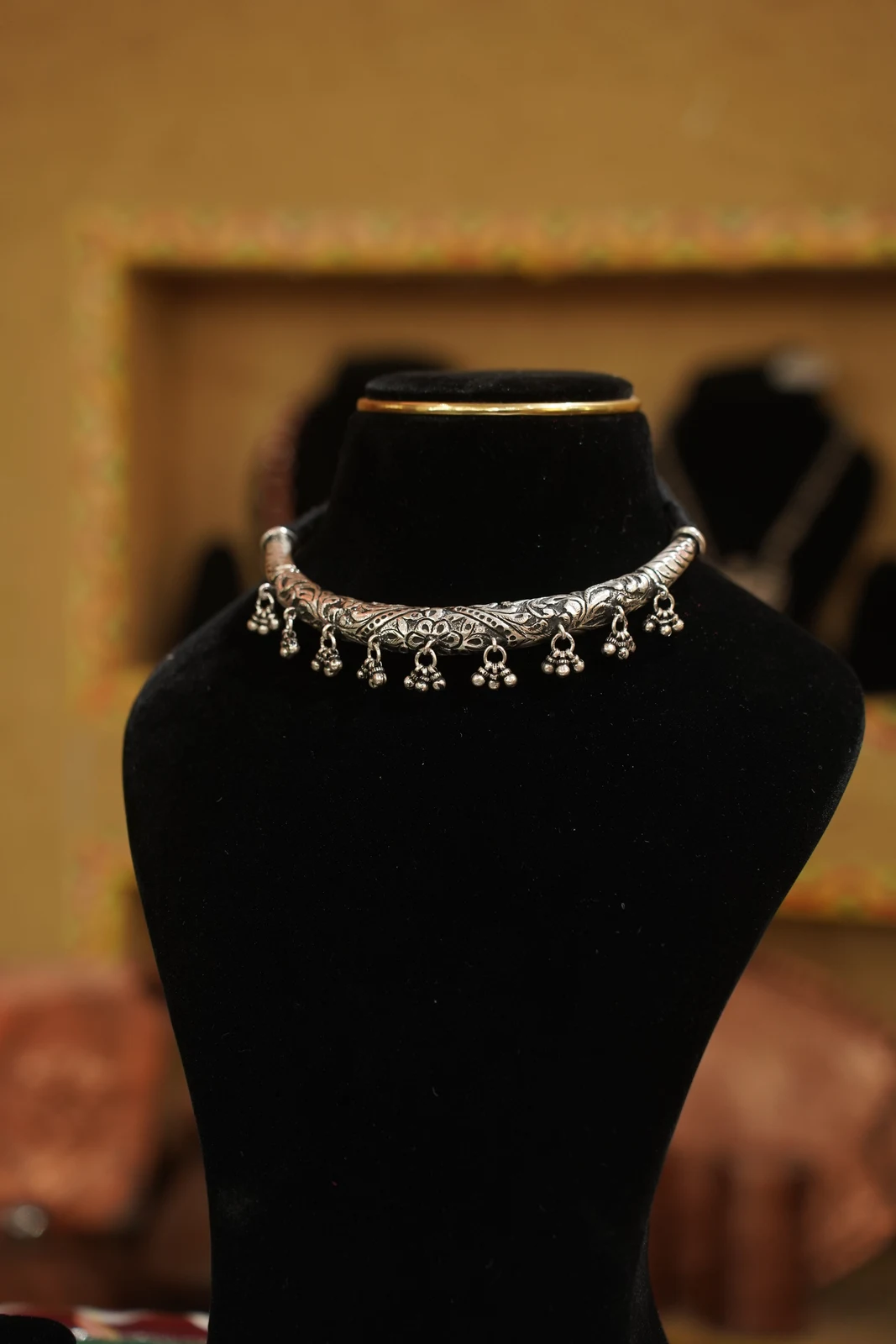
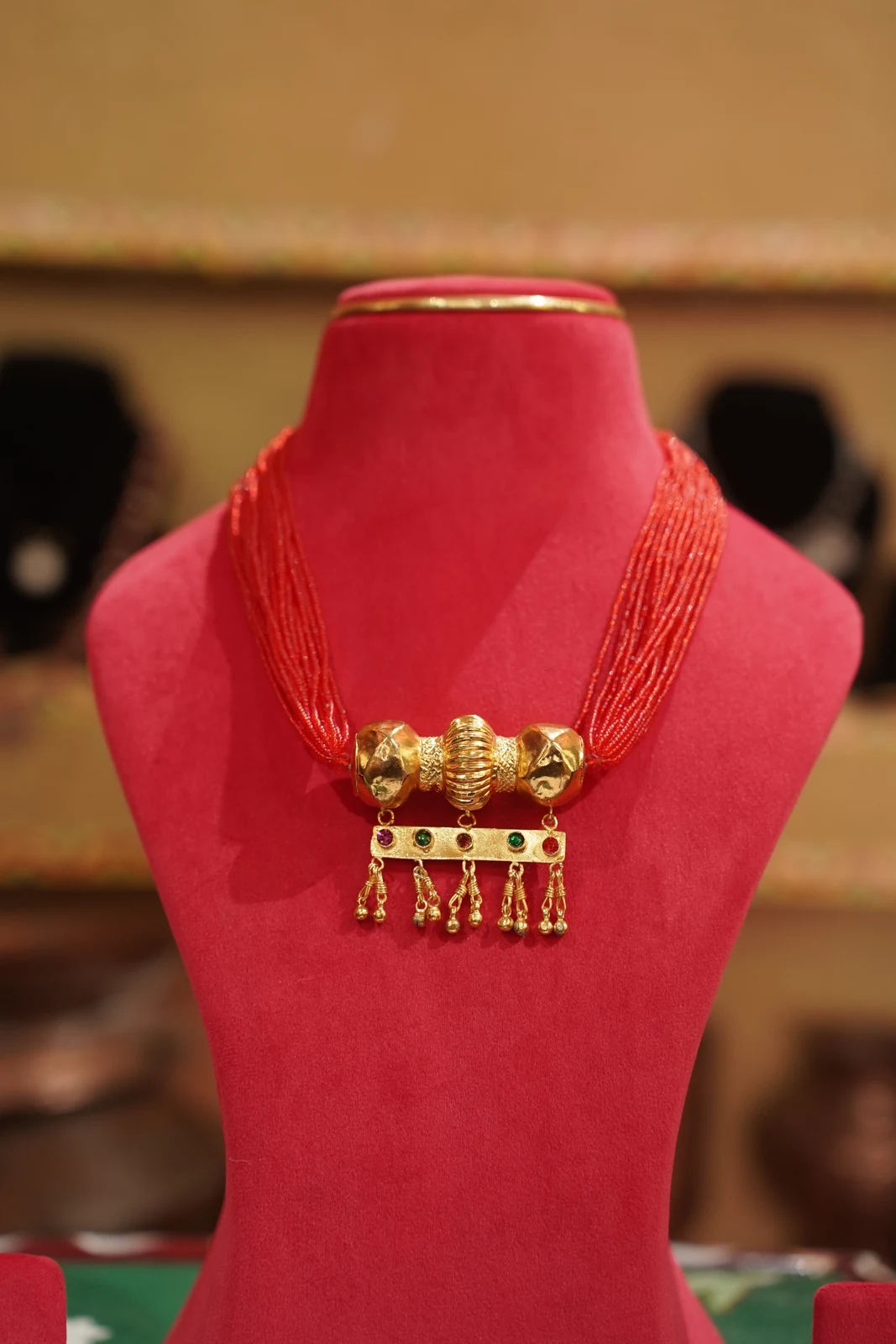
At the neckline, ask what the object is doing physically. Does it hold a continuous rigid curve? Is it built from connected panels? Does a textile layer sit behind its decorative face? How is it fastened? Those questions offer more reliable distinctions than deciding that a particular metal colour belongs to one region.
A collar rewards comparison from more than one angle. Look at the front curve, then compare the opening and the way each piece sits in profile. Two necklaces may share a silhouette while fitting differently. Recording those visible differences gives a family discussion a clear starting point.
A useful side-by-side study might examine two family collars with permission. Record their overall width, openings and visible decoration. Describe any difference plainly: one has a smooth central surface; another has raised decorative elements. Those observations can be checked by another viewer. Calling one “more ancient” or “more authentic” from its photograph adds a claim the photograph cannot carry.
Do the same with panelled chokers. A backing, tie or connection may have been replaced during the object's life. Before interpreting the present colour as an inherited regional convention, ask whether it is original to the remembered piece. A repair history may explain a difference that a neat regional comparison would misread.
Nose jewellery shows why context matters
Nose ornaments attract attention because their placement is so visible in a portrait. A nath's diameter, decorative edge and support arrangement are useful details to record. Yet a bold circular ring alone cannot establish an exclusive origin. The design may be familiar locally while the broader form is shared.
The British Museum's Banjara nath from Saharanpur provides a documented example outside an Uttarakhand-specific attribution. Its record identifies brass as the material. A careful regional comparison therefore needs to describe a particular ring rather than turning the name nath into a universal statement about geography or precious metal.
British Museum's Banjara nath from Saharanpur
The bulak brings another valuable distinction. The V&A records a silver bulak from Uttarakhand, with a form noted in Jaunsar-Bawar and a loop intended for the septum. This is an identified local context within the state's jewellery record. It is a reason to ask a more specific question about community and place, rather than squeezing every example into a simple Kumaon-or-Garhwal answer.
V&A records a silver bulak from Uttarakhand
In a comparison photograph, keep wearing position visible. A nose ring and a septum ornament should not become interchangeable merely because both are described as nose jewellery. Include support pieces in the description, and identify what is known about the photographed arrangement. If a family remembers wearing the same object differently on different occasions, preserve both accounts.
Wrist ornaments need their own close-up
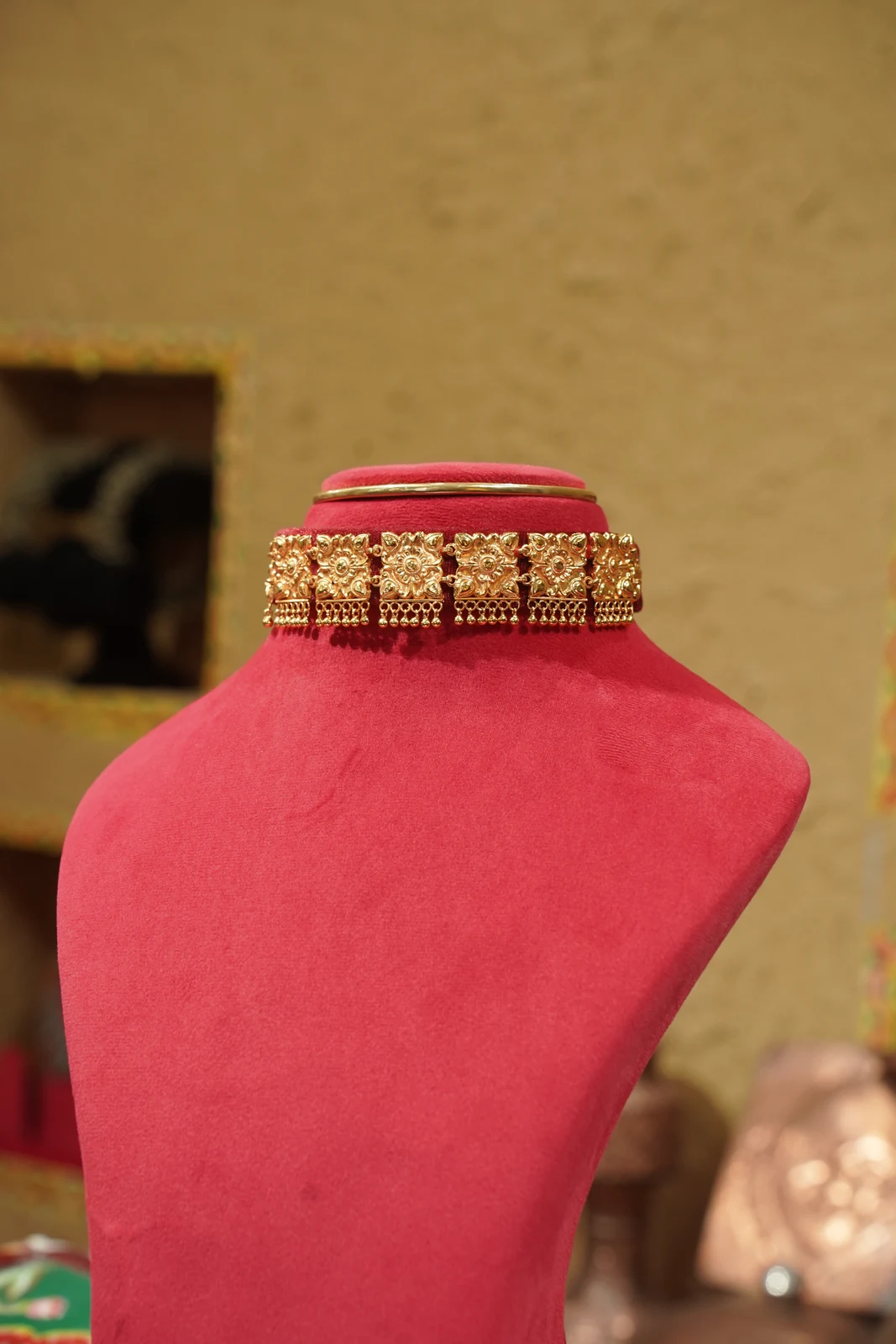
A wedding portrait can hide the most useful details of a bracelet. Hands may be folded, sleeves may cover the fastening, and only the decorative face may be visible. Rather than infer the whole piece from that glimpse, ask for a separate photograph of the wrist ornament itself.
The Met's nineteenth-century pahunchi record uses the broad attribution Northern India. It records gold and silk, and identifies the object as one of a pair. That is solid information about the museum piece, but it cannot supply an exclusive Kumaoni or Garhwali origin where the record does not provide one.
Met's nineteenth-century pahunchi record
For a regional discussion, compare attachment, backing, decorative arrangement and closure across examples whose histories are known. If one account identifies a pair bought in a particular town, retain that detail. If another only establishes that a grandmother wore a similar piece, retain that more limited information too. Different levels of evidence can sit together without being made artificially equal.
Avoid explaining differences through family wealth unless the people concerned have chosen to discuss it and the statement is relevant. A photograph is not a financial record. Jewellery may have been borrowed, inherited, altered or chosen for reasons that have nothing to do with the status a stranger imagines.
Clothing gives jewellery a setting
Jewellery is usually worn with something, and that something affects how we see it. A broad neckline gives a collar one frame; fabric placed higher at the neck gives it another. Colour and drape can emphasise a bracelet or partly conceal it. A comparison that crops out all clothing may lose part of the wearing context.
The Geographical Indications Registry lists Rangwali Pichhoda of Kumaon. The registered identity is a useful, specific reference when discussing Kumaoni textile context. It does not certify the jewellery worn beside the textile, or turn every accessory in a photograph into a Kumaon-made object.
Geographical Indications Registry lists Rangwali Pichhoda of Kumaon
Ask whether the pictured clothes were chosen for the occasion, inherited, borrowed or adapted. Keep an eye on the actual arrangement: where a necklace sits against the fabric, which wrist remains visible, how any support chain is placed. These details help explain styling without requiring a story about a fixed meaning for every colour.
For your own celebration, speak to the people whose family practices you want to understand, then try the complete outfit. A regional label cannot tell you whether a clasp catches your dupatta or a bracelet suits your sleeve. Learning the context and checking the fit belong in the same conversation.
What a fair comparison can say
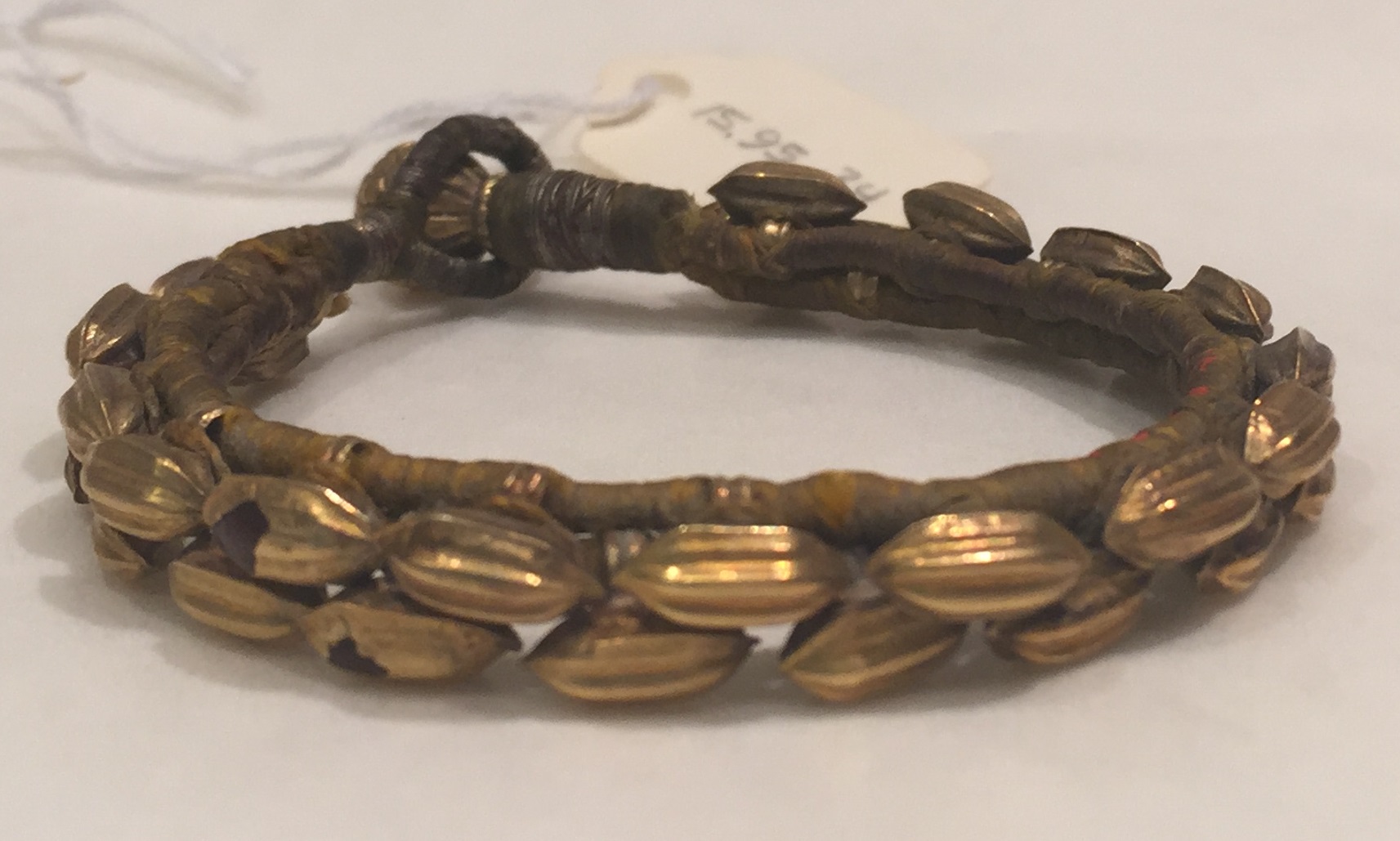
A good comparison makes its scale clear. “These two photographed pieces have different closures” is a narrow, useful observation. “These two families remember different gifting practices” is a comparison of their accounts. Neither statement needs to become a claim that an entire region follows one rule.
It can also acknowledge a shared form without erasing local detail. Two families may both use collar jewellery while giving particular pieces different names or roles. Record the shared category first, then the specific distinction. Readers get an intelligible structure rather than a competition over who owns the category.
A fair comparison separates evidence from interpretation. A museum attribution, a dated invoice and a person's memory are all useful, but they answer different questions. A caption should make that difference visible. You can write that an owner remembers a bracelet being worn at a family wedding without presenting the memory as a museum-certified manufacturing date.
A comparison cannot safely promise an origin for an unrecorded object because it resembles an online image. It cannot establish metal purity from a photograph. And it cannot decide how culturally connected someone is by counting the ornaments they wear. Leaving those judgments aside makes room for the details that actually deserve attention.
Trace an inherited piece without forcing an answer
If you want to understand a piece at home, make a simple sequence of known events. Start with the earliest person who can be connected to it through a photograph or a consented family account. Add later transfers and remembered repairs. Leave a space between events where the record is incomplete; a gap is better than a guessed generation.
Then keep place information in separate fields. Place of manufacture, place of purchase and place of use are not synonyms. If a bill names a shop, record that as purchase evidence. If a relative names a village where the ornament was worn, record that as use. Only describe manufacture when there is evidence that actually concerns making.
Give observations their own space as well. A maker's mark, an engraving or an altered clasp may be worth photographing, but identifying what it means can require expert help. Do not scratch, polish or dismantle a piece merely to make a mark easier to see. Clear photographs and an assessment of the actual object are a better next step.
Finally, write a caption that someone else can understand without your explanation beside it. Name the piece, state what is documented and attribute what is remembered. Date the record and keep the original files. When another relative adds a detail, you can revise the account without losing the earlier version.
Invite local knowledge with better questions
Instead of asking “Is this Kumaoni or Garhwali?”, try “What did your family call this design, and where do you remember seeing it?” The second question allows an answer with a place, a person or a particular occasion. It also lets the speaker explain uncertainty without feeling that they have failed a quiz.
Ask about differences within their experience. Were the pieces worn by sisters identical? Did someone change a backing or have an ornament remade? Was there a piece reserved for an occasion, and who made that decision? Such questions can reveal variation within one family, making a broad regional generalisation less tempting.
A jeweller or other knowledgeable person may be able to explain construction while an elder remembers use. Credit each for the knowledge they actually contribute. Agree whether their name, words and images may be published. Permission to have a private conversation is not automatically permission to turn it into a brand story.
You can make a small comparison album with two or three consented examples. Use the same photograph angles and record fields for each. This gives differences a fair chance to appear, rather than selecting images that exaggerate them. It is also an achievable family project: a few well-described objects are more useful than a large folder of anonymous pictures.
Questions worth carrying forward
Can a necklace tell me whether a photograph is Kumaoni or Garhwali?
It may offer a clue, especially to someone familiar with the actual local design, but it should not be the sole basis for a confident identification. Ask who is pictured, where and when the photograph was taken, and what is known about the ornament. Shared jewellery forms make context essential.
Is choosing jewellery from another tradition disrespectful?
Begin by learning what you are choosing and how it is described. Listen when a wearer or maker explains a specific custom, give credit when sharing their knowledge, and avoid presenting someone else's story as your own. For a family ceremony, discuss expectations directly with the people involved rather than looking for one internet rule.
What should an educational comparison leave readers with?
It should leave them able to name an object more accurately, notice its construction and ask a better question about its story. Readers should understand both regional context and the limits of an unsupported label. A respectful comparison creates curiosity about real people and real objects; it does not hand out marks for belonging.
Kumaon and Garhwal are worth exploring in detail. The strongest beginning is often close at hand: a photograph whose owner can identify the occasion, a bracelet whose fastening someone remembers, a necklace whose history can still be asked about. Start there, and let the comparison grow from evidence rather than from a ready-made divide.
Explore the current Hansuli jewellery collection
Ask Hansuli about a specific design, fit or material description