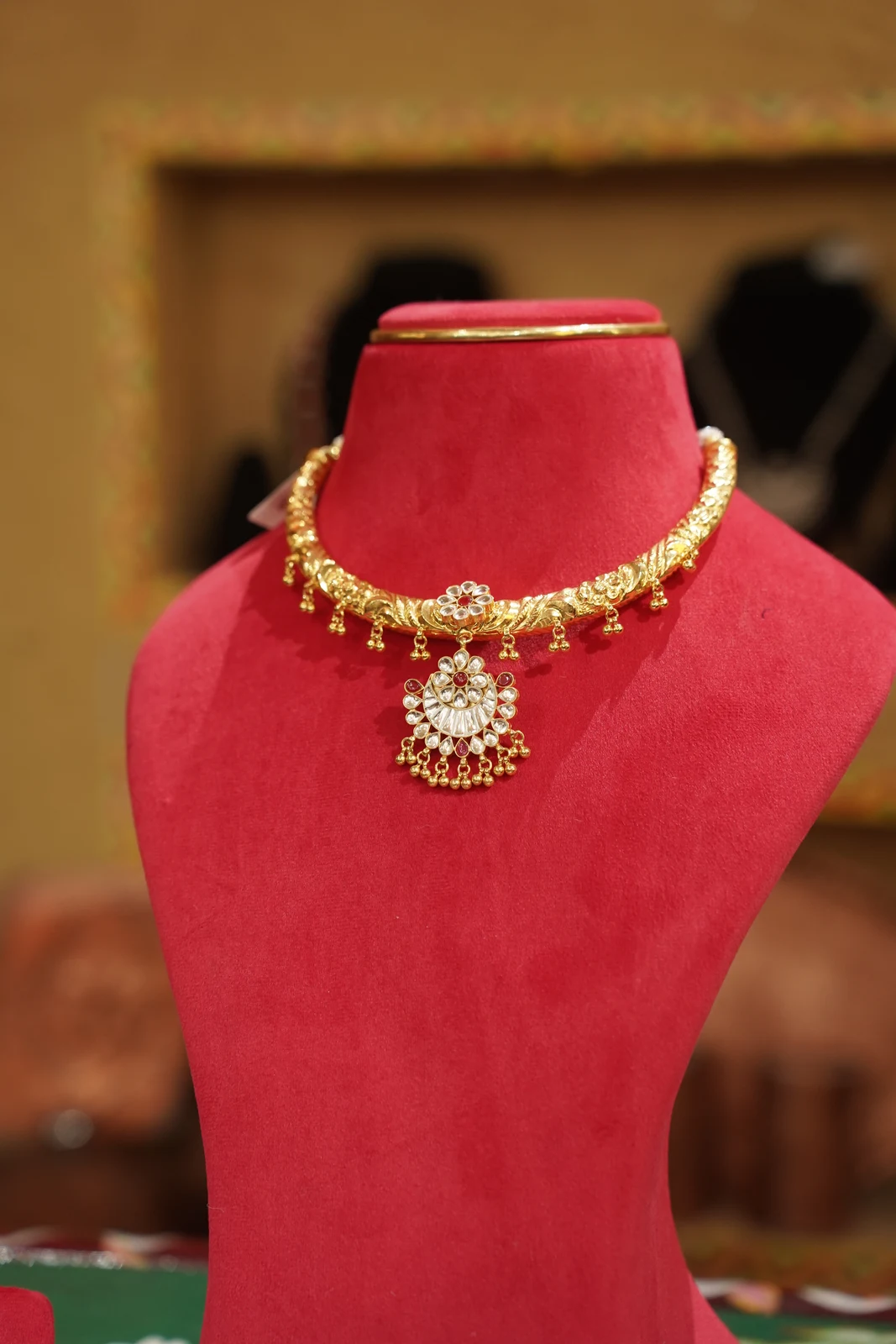
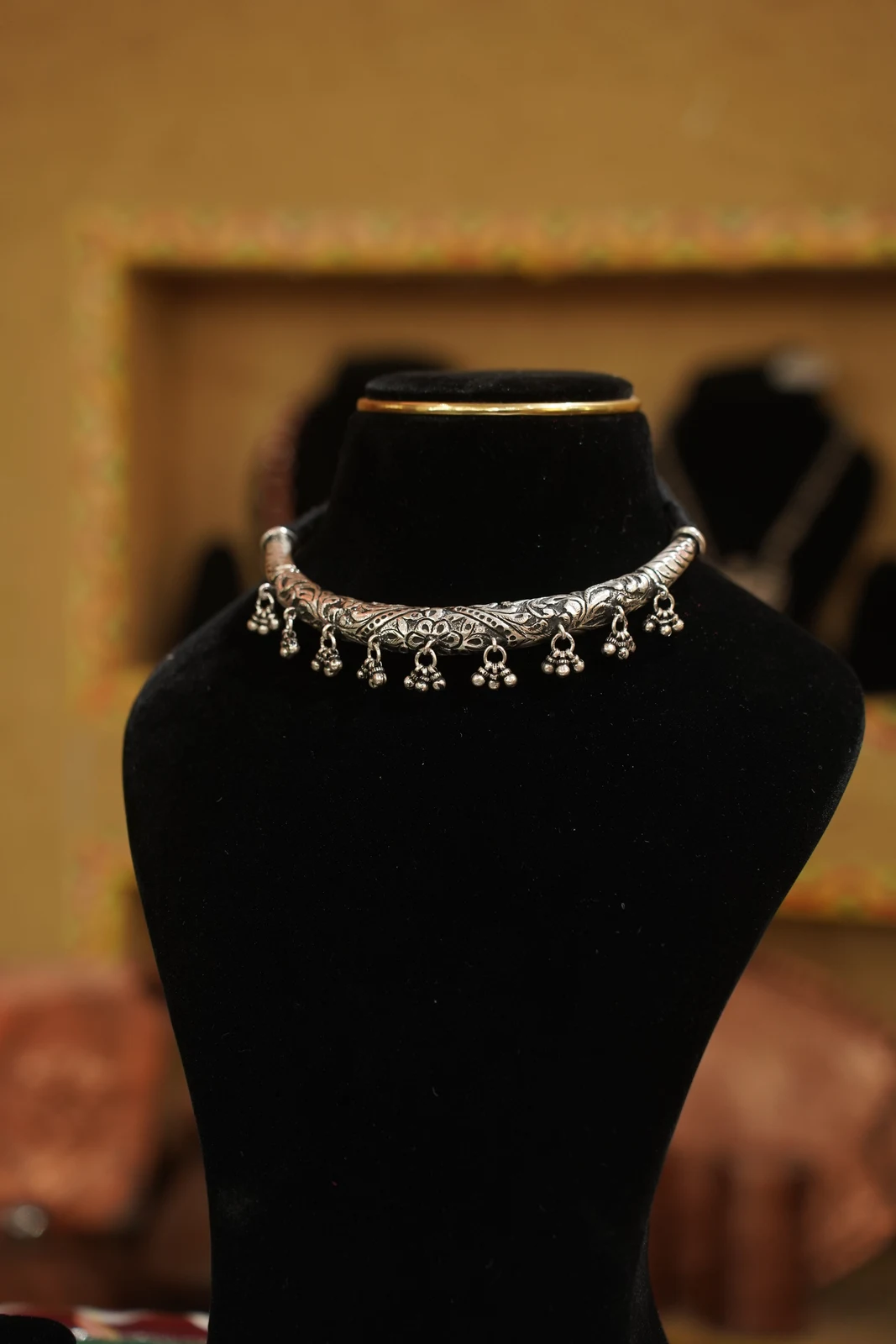
Hansuli is a rigid collar necklace; guloband is a close-fitting neck ornament often arranged in separate units; paunchi is wrist jewellery; nath is a nose ring; bulak is a septum ornament. Names and local uses vary. Identify the actual construction and preserve each family's account rather than assigning origin or meaning from a name alone.
A family photograph can hold a whole jewellery lesson. Look past the familiar face and notice the wrist, the neckline, the small ornament beneath the nose. You may recognise every piece without knowing what to call it. Or you may know the names from home and discover that someone from another valley uses a different spelling. Learning those details brings an old photograph closer. It also helps us describe the jewellery we choose today with more care.
Five useful names to begin with are hansuli, guloband, paunchi, nath and bulak. The hansuli is a rigid collar necklace; the guloband is a close-fitting neck ornament often organised into separate units; paunchi refers to wrist jewellery; a nath is a nose ring; and a bulak is a septum ornament. They occupy different places on the body and deserve separate attention. Their family meanings cannot be read from their names alone.
Start with the object, then ask its name
If an ornament is in front of you, begin with a simple description. Where would it sit? Is it rigid or flexible? Does it have a tie, a hook, a loop or a clasp? How are the decorative parts connected? These observations are more useful than guessing its age from a darkened surface or declaring its origin from one flower-shaped detail.
Spellings vary when local speech is written in English. You may encounter paunchi, pahunchi, paunji or paunjhi, and guloband, galobandh or guluband. Keep the spelling your family uses alongside a common search spelling. A recording of the spoken name can be especially helpful. Search engines need readable words; a family record should also preserve the sound of those words.
Separate three questions: what kind of object is this, where did this particular object come from, and what did it mean to its wearer? A form can travel. A piece can be bought in one town and worn in another. Its meaning may change when it passes from a mother to a daughter. Answering one question does not automatically answer the other two.
Hansuli: recognise the continuous collar
The easiest place to begin is the silhouette. A hansuli holds its curve rather than hanging like a chain. It frames the base of the neck, so the relationship between the ornament and the collarbone is central to recognising it. Decoration may be prominent or restrained; the continuous rigid form remains the useful starting point.
Indian Family Jewels' Hasli exhibit documents this collar form and names including hasli and hansuli. Its wider Indian context matters. A necklace can be cherished in Uttarakhand without needing a claim that every example originated there. Shared forms and deeply local attachments can exist together.
Indian Family Jewels' Hasli exhibit
When studying your own example, photograph the whole curve before photographing its ornamentation. Then look at the ends and the opening mechanism. Is there a hinge, a removable section or an open gap? Describe what you can actually see, without forcing the piece into a standard pattern. The details of an individual necklace often tell you more about wearing and handling it than a general description does.
For contemporary wear, think about the space the collar needs. Try it with the actual neckline rather than deciding from a flat product image. Move your shoulders, sit down and turn your head. If it presses against you or catches fabric, ask about fit instead of trying to bend it yourself. Appreciation becomes much easier when the piece feels comfortable enough to wear.
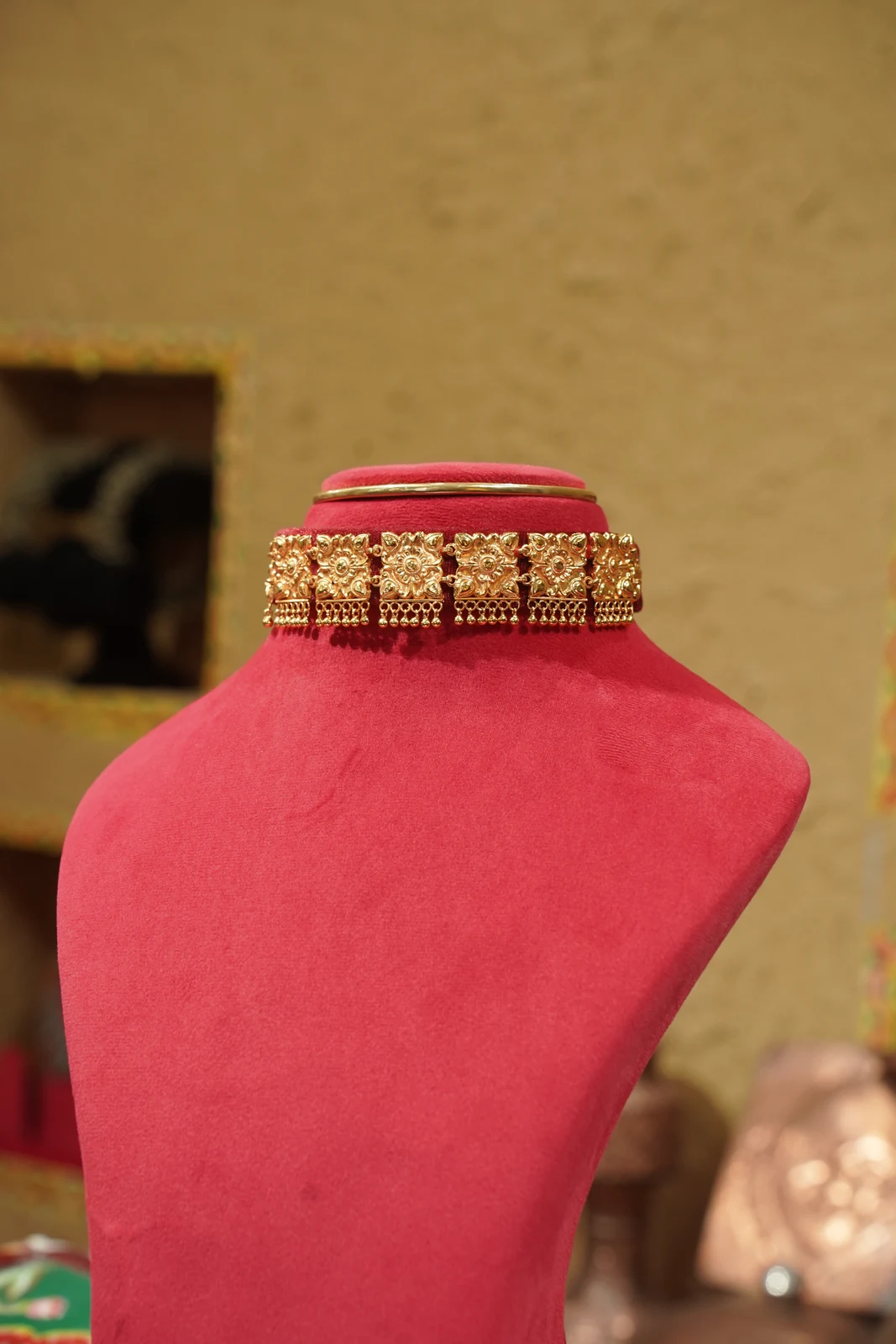
Guloband: follow the separate units
A guloband and a hansuli may both sit near the neck, but looking at their construction helps distinguish them. With a panelled guloband, the eye moves across individual elements. The connections, backing and fastening matter as much as the front. A photograph taken straight on can hide all three.
The National Museum, New Delhi's guluband record describes an example built from nine square panels, with a decorated reverse. This is a documented object from Delhi, rather than evidence that every Uttarakhand guloband has nine panels or the same materials. It offers a useful lesson in how to look: count the units, examine their edges and remember to turn the object over.
National Museum, New Delhi's guluband record
If your family's piece has a textile backing, record its colour and condition separately from the metal. Ask whether the cloth has been replaced. A newer backing does not erase an older ornament's family story, but it changes what the current object can tell you. The same applies to a replaced tie or a repaired connection between panels.
When buying a contemporary interpretation, ask how the units are secured and whether the backing can be serviced. Check the feel of the edges against your neck. A broad choker can look balanced in a photograph yet feel different after an hour of sitting and talking. Choose the fit for your own body rather than treating discomfort as a requirement of a traditional appearance.
Paunchi: pay attention to the wrist
Paunchi belongs to the wrist, where jewellery has to move with the hand. Before concentrating on the decorative surface, look at how the piece closes. A wrist ornament may be tied, hinged or otherwise fastened; a familiar name does not guarantee one mechanism. Check whether you are looking at a single piece or one of a pair.
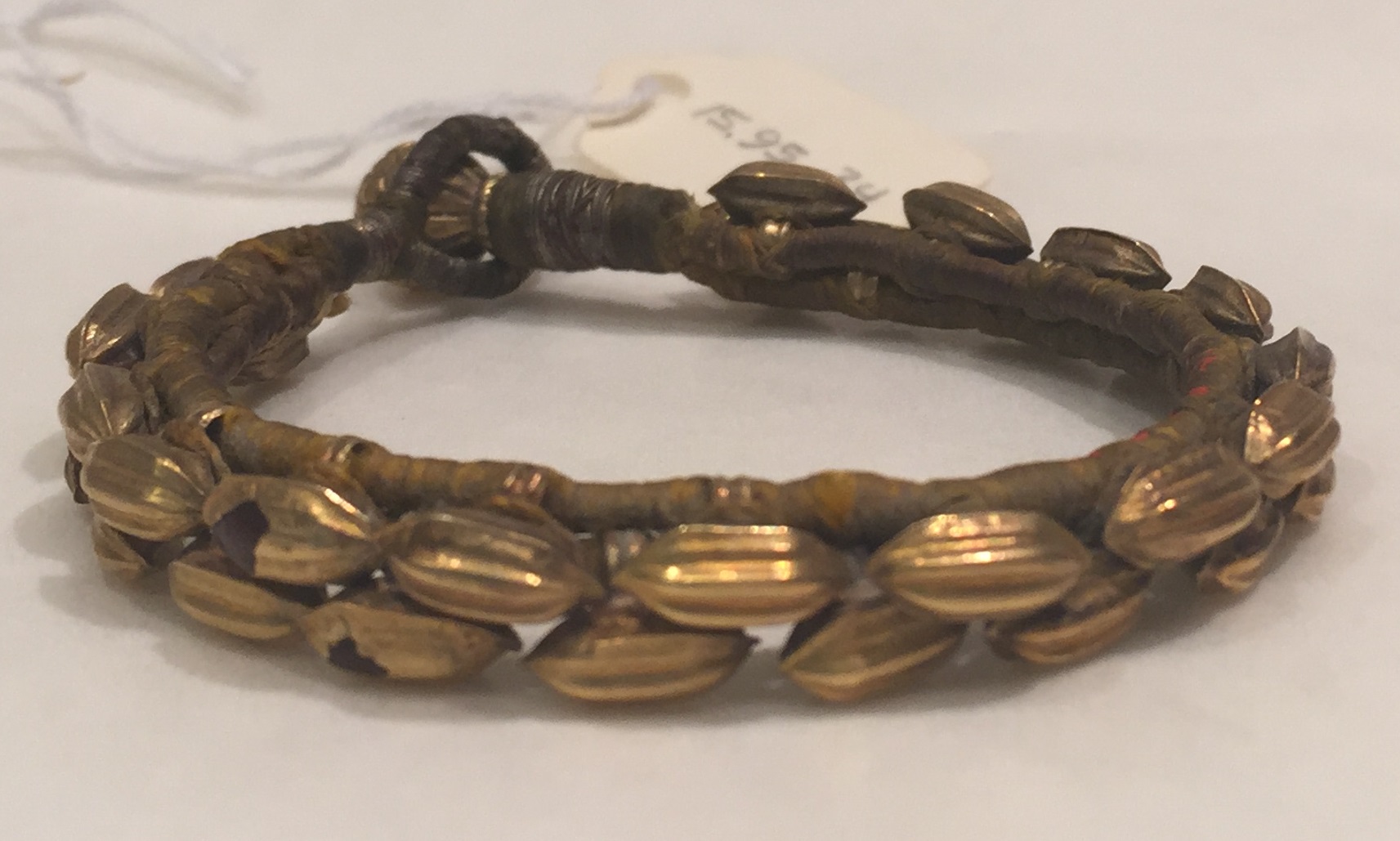
The Metropolitan Museum of Art records a nineteenth-century pahunchi made with gold and silk, decorated with seed-shaped elements. Its attribution is Northern India. That broad description should stay broad: it is not a documented label assigning this particular bracelet to Kumaon or Garhwal. The object provides a historical example of the name and form without settling a local family history.
Metropolitan Museum of Art records a nineteenth-century pahunchi
For your own piece, note whether the decorative elements sit in rows and how they are attached. Photograph the inside, the closure and any fabric that supports the visible parts. If a pair has small differences, record both rather than assuming one photograph represents them equally. A changed tie, missing element or separate repair may belong to only one wrist.
Try modern wrist jewellery while doing ordinary movements: hold a cup, bend your wrist and reach for your bag. Check that the closure stays secure and the ornament does not trap a sleeve. If you are borrowing an older piece for a celebration, agree in advance who will fit and remove it. A hurried attempt to tighten an unfamiliar fastening can turn a happy occasion into an avoidable repair.
Nath: the ring and the way it is worn
The nath is recognised as a nose ring, but a name alone does not describe its scale, support or decoration. Begin with its ring, then examine any attached elements and the fastening. If a support chain is present, include it in the record. It is part of the arrangement, not an incidental accessory to crop out of the photograph.
A British Museum object identified as a nath was made by Banjara makers in Saharanpur District and is catalogued as nineteenth-century brass jewellery. That example is outside an Uttarakhand-specific provenance claim. It shows why neither the word nath nor a circular form proves one region, one metal or one family custom.
British Museum object identified as a nath
When discussing a wedding photograph, ask who the ornament belonged to and whether it was purchased, borrowed or inherited. Those answers can explain why a particular ring appears in a family album without turning that choice into a rule for every bride. A large ring may be memorable, but its diameter cannot tell you a woman's happiness, standing or relationship with her heritage.
For a purchase or a loan, discuss the intended fitting with someone qualified to assess the actual piece. A pierced ornament and a clip-on interpretation are different products. Do not assume either is suitable because it looks like an image you admire. Bring the hairstyle and any support arrangement into a trial fitting, and let comfort help decide how long you will wear it.
Bulak: distinguish the septum ornament
The bulak, also written bulaq, is easy to confuse with other nose jewellery if the wearing position is missing from a picture. The useful distinction is its relationship to the septum, the central division between the nostrils. An isolated product photograph needs a clear description; a worn photograph needs enough context to show placement without exposing someone's identity unnecessarily.
The Victoria and Albert Museum's silver bulak from Uttarakhand is an especially useful record. The museum notes a form associated with Jaunsar-Bawar and describes a loop designed to pass through the septum. Its decoration includes coloured varnishes that imitate enamel. This specific object also reminds us that bulaks cannot accurately be described as universally made of gold.
Victoria and Albert Museum's silver bulak from Uttarakhand
That record belongs to one object and its documented context. It does not establish a single shape for every bulak, or one meaning for every wearer. If someone in your family remembers a different form, photograph it and record the name they use. Compare the construction and wearing position before deciding that one memory must be mistaken.
If an older bulak will be worn again, have its fastening and condition assessed. Do not reshape a small loop or attempt to adapt a historical piece to a different fitting at home. If it will be photographed rather than worn, that is a worthwhile way to keep it visible too. An ornament does not lose its place in a family story because its next owner chooses a different relationship with it.
Who holds the knowledge?
A useful jewellery conversation includes more than the person who owns the most elaborate piece. The relative who remembers where it was bought, the person who maintained its cloth, the jeweller who repaired it and the wearer who can explain its fastening may each know something different. Put those accounts beside one another. Agreement is valuable, and so is an honestly recorded difference.
Ask for specifics: which town, which occasion, which person, which change? A story about an actual purchase or repair is easier to preserve than a sweeping statement about what everyone once wore. If a date is approximate, keep it approximate. Do not turn “before my wedding” into an exact year unless another record supports it.
Respect also includes what you leave out. Someone may be happy to discuss a necklace but not its cost, inheritance dispute or present location. Get permission before sharing a portrait, a recording or a family name. You can teach an ornament's form without publishing details that make its owner uncomfortable.
Make a small identification record
Choose one piece and create a page for it. Begin with the local name, the common English spelling and the body position. Add front, reverse and fastening photographs. Place a ruler beside the object if it can be done without handling risk; record the unit of measurement so the number remains useful later.
Keep material information separate from appearance. “Yellow metal” is an observation; “gold” is a material claim. “Silver-coloured” does not establish silver purity. Copy documented specifications accurately, and keep invoices or assessment notes with the record. If a detail is unknown, leave it unknown rather than borrowing a claim from a similar-looking catalogue item.
Add a short ownership sequence only with permission. It can be as simple as who wore it first within living memory, who looks after it now and who supplied the account. Give the record a date and retain an editable copy. A later discovery should be able to improve the account instead of being trapped behind an impressive but inaccurate caption.
Choosing a contemporary piece with care
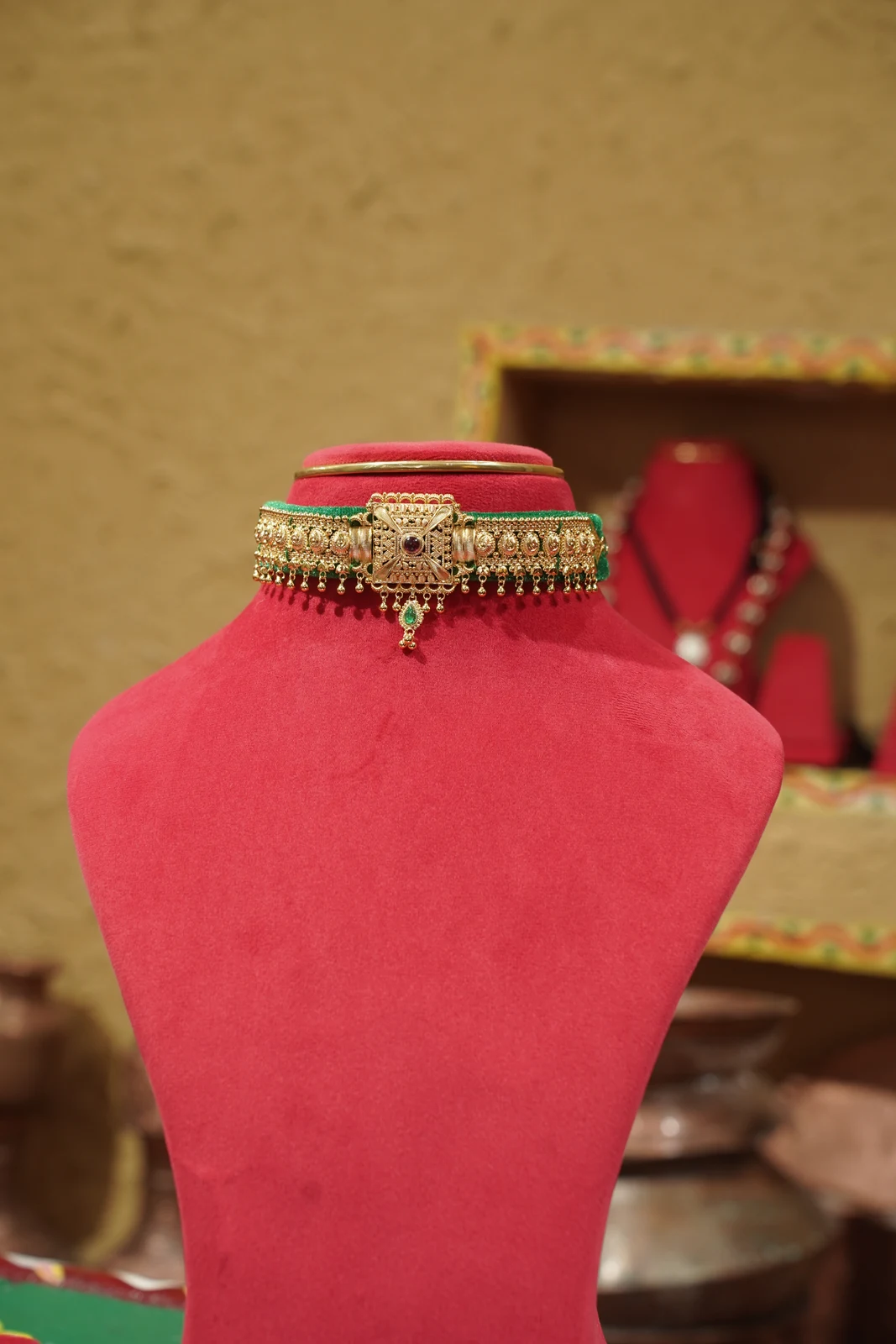
Knowing the names makes shopping more precise. You can ask for a rigid collar rather than a panelled choker, or explain that you need wrist jewellery rather than a necklace inspired by its surface pattern. Send a reference image when words are ambiguous, and ask the seller to describe the actual construction shown.
Look for information about dimensions, weight, fastening, base material and finish on the specific item. A traditional name is not a material certificate. A modern design can borrow a familiar silhouette while changing its scale or construction; the useful question is whether those changes have been described clearly enough for you to choose.
Within Hansuli's current collection, treat catalogue photographs as examples of contemporary jewellery. Compare visible details with the item description, and ask for clarification through the store's contact page when needed. None of the five names in this guide is a promise that a corresponding design is currently in stock. A thoughtful enquiry is better than an assumption based on an article illustration.
Questions readers often ask
Are hansuli and guloband the same ornament?
They can occupy a similar area around the neck, but the construction differs. A hansuli is recognised by its rigid collar form. A panelled guloband is assembled from separate decorative units. Examine the whole piece and its fastening, since contemporary interpretations may adapt either description.
Does paunchi mean an ordinary bangle?
It identifies a wrist ornament, but it should not be used to assume every closed bangle has the same construction or cultural history. Ask about the specific piece, including its decorative elements, backing and closure. Preserve the name used by its owner alongside a clear physical description.
Can an ornament's name prove where it was made?
Usually, the name alone cannot do that. Provenance needs evidence relating to the particular object: a maker's record, purchase history, documented attribution or a carefully recorded family account. A shared name may be useful for identifying a form while remaining insufficient for identifying its place of manufacture.
Where should a beginner start?
Start with the piece your family can explain best, even if it is small or recently made. Learn its name, look at its construction and ask one good question about its story. Knowing five famous names is useful; being able to describe one real ornament accurately is a much stronger beginning.
Explore the current Hansuli jewellery collection
Ask Hansuli about a specific design, fit or material description